|
Allison V-1710 Engine |  |
||||||||
|---|---|---|---|---|---|---|---|---|---|---|
 |
 |
 |
 |
 |
 |
 |
 |
 |
 |
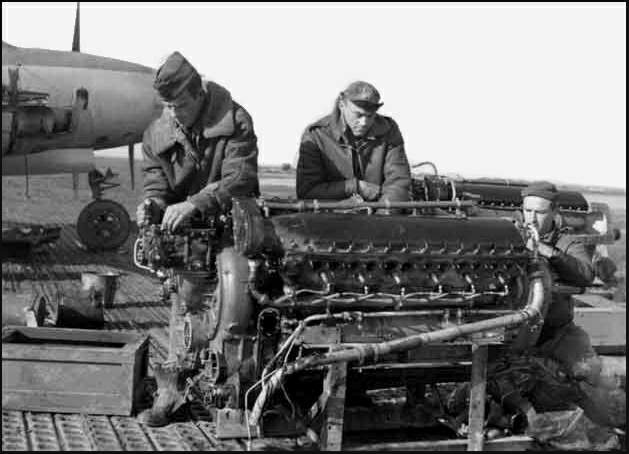 Mechanics preparing an Allison V-1710 engine to be installed on a Lockheed P-38 Lightning . The only American liquid-cooled engine to see service in World War II was the Allison V-1710. It was one of the most important large USA aero engines, with over 70,000 engines produced from the time of the first in 1931 to the last in 1948. The engine was produced for several important fighters of WWII, including the P-38 Lightning, P-39 Airacobra, P-40 Warhawk, P-51A Mustang, P-63 Kingcobra, P-82 Twin Mustang and the Consolidated XA-11A, an experimental attack version of the Consolidated P-25. Allison was an Indianapolis firm that had done well in a small way with Liberty engine modifications and with reduction gears for others' engines.
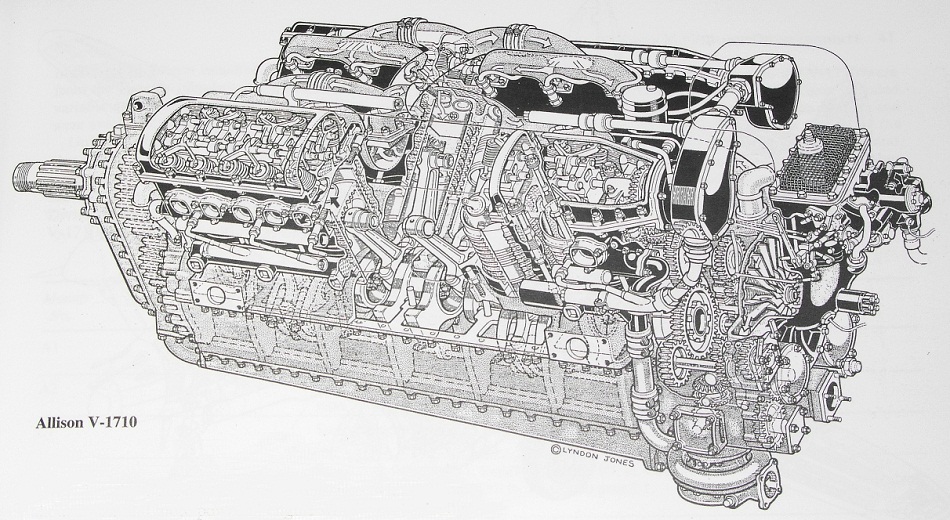
Around the time the Army was washing its hands of the Curtiss Conqueror, Allison began to develop its own engine, at the request of Allison General manager Norm Gilman. The target was 1,000 hp, and Allison intended that the engine should be large enough to deliver this power easily. A successful V-1710-A was test-run in 1931 and delivered 650 hp at 2,400 RPM on 80-octane fuel. Development proceeded slowly until the Navy entered the picture. The Navy, while not losing its attachment to air-cooled power plants for airplanes, it still needed liquid cooling for dirigibles. The Navy requested eliminating the supercharger (rotary induction blower) in favor of two carburetors placed in the Vee of the engine. A significant redesign was undertaken by R.M. Hazen in 1936. This "C"-model passed its 150-hour type acceptance test in 1937, establishing a rating of 1,000 hp at 2,600 rpm at sea level. A number of incremental improvements were made during the life of the "C"-model, eventually leading to "C"-models with takeoff ratings of 1,150 hp at 2,950 rpm and supporting 3,500 rpm for overspeed during dives.
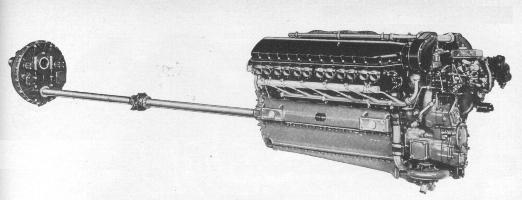 The V-1710-E18 & E19 engine with extension shaft and outboard reduction gear box used on the P-39 Airacobra. The production Allison turned out to be the sturdy and reliable powerplant that its designers strived for. The only thing that stood between the Allison and real greatness was its inability to deliver its power at sufficiently high altitudes. This was not the fault of its engineers. It resulted from an early Army decision to rely on turbo-supercharging to obtain adequate power at combat heights. Even this decision was not a technical error—a turbo-supercharged Allison was as good as any high-altitude engine. The trouble was that the wartime shortage of alloying materials, especially tungsten, made it impossible to make enough turbo-superchargers for the entire Allison production. Therefore, bombers such as the Boeing B-17 Flying Fortress and Consolidated B-24 Liberator, running radial engines, were given priority over all others in regards to turbo-superchargers. The few turbo-supercharged Allisons that were made, were allocated to P-38s, making the high-altitude performance of that plane its best feature. All early P-40s were equipped with gear-driven superchargers, and as a result, were never first-class fighter planes. Donaldson R. Berlin, the P-40's designer, has said that P-40s experimentally equipped with turbo-superchargers outperformed Spitfires and Messerschmitts and that if it had been given the engine it was designed for, the P-40 would have been the greatest fighter of its era. Some may say this is an exaggeration by Berlin, because when Rolls-Royce Merlin engines were installed in Curtiss P-40Fs and P-40Ls, they were still no match for the best fighters of the day. It wasn't until the XP-40Q was modified with a "bubble" canopy, cut-down rear fuselage, wing radiators, clipped wing tips, a four-blade propeller, water injection and weight reduced to 9,000 lbs. that the XP-40Q attained a maximum speed of 422 mph. However, there is no doubt that the deletion of the turbo-supercharger limited the P-39 Airacobra to low-altitude operations. Had Allison's engineers been able to put the effort into gear-driven superchargers that Pratt and Whitney and Rolls-Royce did, it might have been a different story. As it was, there can be little doubt that the V-1710 had more potential than was actually exploited. Allison became a part of General Motors in 1929, and the firm was a GM component known as Detroit Diesel Allison Division until 1995. The company was then acquired by Rolls-Royce Group plc and is now a subsidiary of the Rolls-Royce Corporation.
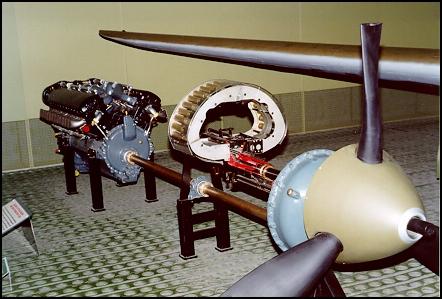 The V-1710-85 engine with extension shaft and outboard reduction gear box used on the P-39 Airacobra. (Photo: National Museum of the US Air Force.) |
|||||||||
| Specifications: | |
|---|---|
| Allison V-1710-G6 | |
| Date: | 1941 |
| Cylinders: | 12 |
| Configuration: | V type, Liquid cooled |
| Horsepower: | 1,250 hp (932 kw) |
| R.P.M.: | 3,200 |
| Bore and Stroke: | 5.5 in. (140 mm) x 6 in. (152 mm) |
| Displacement: | 1,710 cu. in. (28 liters) |
| Weight: | 1,595 lbs. (707 kg) |
|
Ed. Ralph D. Bent, James L. McKinley. Aircraft Power Plants by the Northrop Aeronautical Institute. (New York: McGraw Hill, 1955.) |
©Larry Dwyer. The Aviation History On-Line Museum.
All rights reserved.
Created November 28, 2006. Updated September 25, 2023.