| Wright Cyclone R-1820 |
| ||
|---|---|---|---|
 |

| ||
 |
|||
|
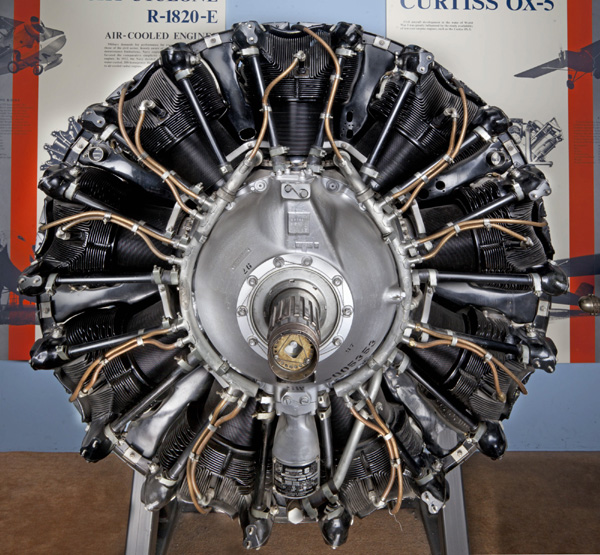
The nine cylinder G Cyclone R-1820-G2, has a rating of 1,000 hp for take-off. | |||
| The Wright Cyclone R-1820 was a 9 cylinder, single-row, air-cooled radial engine. Horsepower ranged from 700 hp to 1,500 hp depending on the model and configuration. Wright Cyclone R-1820 engines were produced from 1931 until well into the 1950s by several companies under license that included Studebaker, Lycoming and Pratt & Whitney. It was also built in the Soviet Union as the M-25 and in Spain as the Hispano-Suiza 9V. It powered a range of aircraft that included the Boeing B-17 Flying Fortress, Grumman J2F Duck, Curtiss P-36, Boeing 307 Stratoliner and Douglas SBD Dauntless.1 |
| At the time, the Wright G Cyclone Series represented the latest air-cooled aircraft engine developed by the company. Although of the same displacement (1,820 cubic inches) as the F and the F-50, the G Series engines incorporated many refinements and improvements in design principal. Among them was: |
| • | Increased cooling fin area of 2,800 square inches as opposed to 1,000 square inches in other Cyclone models. | |
| • | Advancement in foundry techniques to cast cooling fins on the G cylinder head as closely spaced as the teeth on a comb and nearly two inches in depth over the combustion chamber. | |
| • | Cylinder barrels made of of Nitralloy steel, nitrided to obtain a cylinder bore with a surface with three times the wear resistance of ordinary heat-treated cylinder barrels. |
| Five large nitriding furnaces were installed to accommodate the daily output of Cyclone G cylinders. More accurate fuel control and the improved cylinder heads on the G Cyclone engine permitted a rating of 1,000 hp at take-off with a weight in certain models of 1.07 pounds per horsepower and fuel consumption of .43 pounds per horsepower at cruising speed. |
 |
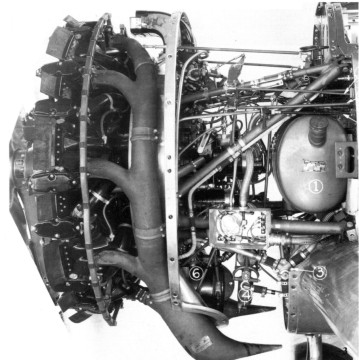 |
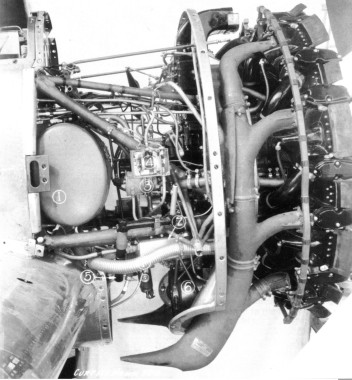
| Other features of the design and construction of the G Series Cyclones were: | ||
| • | Full pressure baffling of the cylinders. | |
| • | Induction systems to increase altitude performance. | |
| • | Improved oil seals and refinements in the supercharger. | |
| • | Mechanism for the operation of two-position hydro-control and constant speed propellers. | |
| • | Automatic lubrication of the valve gear from a built-in system devoid of all external lines or tubes. | |
| • | An accessory section provided with the driving mechanism necessary to meet all of the requirements of modern military and civil transport service. | |
| • | A dynamic damper counterweight which counteracts torsional vibration at all crankshaft speeds and removes all restrictions in the operating range. | |
| The G Cyclone was produced in four geared models and their direct drive counterparts. These were: | ||
| • | Cyclone GR-1820-G1 rated at 940 hp for take-off, 825 hp at sea level, and 850 hp at 3,000 feet. | |
| • | Cyclone GR-1820-G2 rated at 1,000 hp for takeoff, 810 hp at sea level, and 850 hp at 5,500 feet. | |
| • | Cyclone GR-1820-G3 rated at 875 hp for take-off, and 840 hp at 8,700 feet. | |
| • | Cyclone GR-1820-G6 rated at 820 hp for take-off and 815 hp at 10,500 feet. | |
| The various G Cyclone models differ only with respect to the amount of supercharging applied: | ||
| • | The G-1 has a blower gear ratio of 5.95 to 1. | |
| • | The G-2 a blower ratio of 7 to 1. | |
| • | The G-3 a blower ratio of 8.31 to 1. | |
| • | The G-6 a blower ratio of 8.83 to 1. | |
| All the G Series engines are of the nine-cylinder radial air-cooled type and have the following characteristics: | ||
| • | Bore: 6.125 inches. | |
| • | Stroke: 6.875 inches. | |
| • | Compression ratio: 6.45 to 1. | |
| • | Engine diameter: 54 1/4 inches. | |
| • | Length: 43 1/4 inches. | |
| • | Dry weight (geared): 1,163 pounds. | |
| • | Dry weight (direct drive): 1,068 pounds. | |
| The F-50 Series Cyclone was produced in four direct drive models and their geared counterparts. These were: | ||
| • | Cyclone R-1820-F52 rated at 890 hp. for take-off, 745 hp at sea level, and 775 hp at 5,800 feet. | |
| • | Cyclone R-1820-F53 rated at 785 hp for take-off, 685 hp at sea level and 745 hp at 9,600 feet. | |
| • | Cyclone R-1820-F54 rated at 655 hp for take-off, 605 hp at sea level, and 690 hp at 15,300 feet. | |
| • | Cyclone R-1820-F56 rated at 785 hp for take-off, 695 hp at sea level, and 755 hp at 11,300 feet. | |
| The F-50 Series Cyclone was produced in four direct drive models and their geared counterparts. These were: | ||
| • | The F-52 has a blower gear ratio of 7 to 1. | |
| • | The F-53, a blower gear ratio of 8.31 to 1. | |
| • | The F-54 a blower gear ratio of 10 to 1. | |
| • | The F-56, a blower gear ratio of 8.83 to 1. | |
| Characteristics common to all F-50 models are: | ||
| • | Bore: 6.125 inches. | |
| • | Stroke: 6.875 inches. | |
| • | Compression ratio: 6.40 to 1. | |
| • | Diameter: 54-1/8 inches. | |
| • | Dry weight (geared): 1,070 pounds. | |
| • | Dry weight (direct drive): 975 pounds.2 | |
| In the early 1930s, Wright had been manufacturing a variety of both air-cooled and liquid-cooled engines and it was at this time that they decided to concentrate their efforts on the R-1820 Cyclone. Wright stopped development on every engine except the Cyclone. By 1932, the engine rating of the Cyclone had increased to 700 hp and Wright also adopted the forged crankcase which had marked the Pratt & Whitney Wasp and Hornet from the beginning. The Cyclone had become a topflight engine and it was selected to power the Douglas DC-2, the forerunner of the famous DC-3.3 |
| Specifications: | |
|---|---|
| Wright Cyclone R-1820-G2 | Date: | 1931 |
| Cylinders: | 9 |
| Configuration: | Single-row, Air-cooled radial |
| Horsepower: | 1,060 hp (790 kw) |
| R.P.M.: | 2,200 |
| Bore and Stroke: | 6.125 in. (155.6 mm) x 6.875 in. (174 mm) |
| Displacement: | 1,823 cu. in. (29.88 liters) |
| Weight: | 1,184 lbs. (537 kg) |
Endnotes:
|
1. Herschel Smith. A History of Aircraft Piston Engines. Manhattan, Kansas: Sunflower University Press, 1993. 125. 2. Howard Mingos, ed. The Aircraft Year Book for 1937. New York: Aeronautical Chamber of Commerce of America, Inc., 1937. 374-379. 3. The Pratt & Whitney Aircraft Story. Pratt & Whitney: 1950. 110. |
© Larry Dwyer. The Aviation History On-Line Museum. All rights reserved.
Created July 25, 2000. Updated October 12, 2013.