| Pratt and Whitney Engines 1937 - USA |
| ||
|---|---|---|---|
| Home Page | Engine Index | ||
![]() |
|||
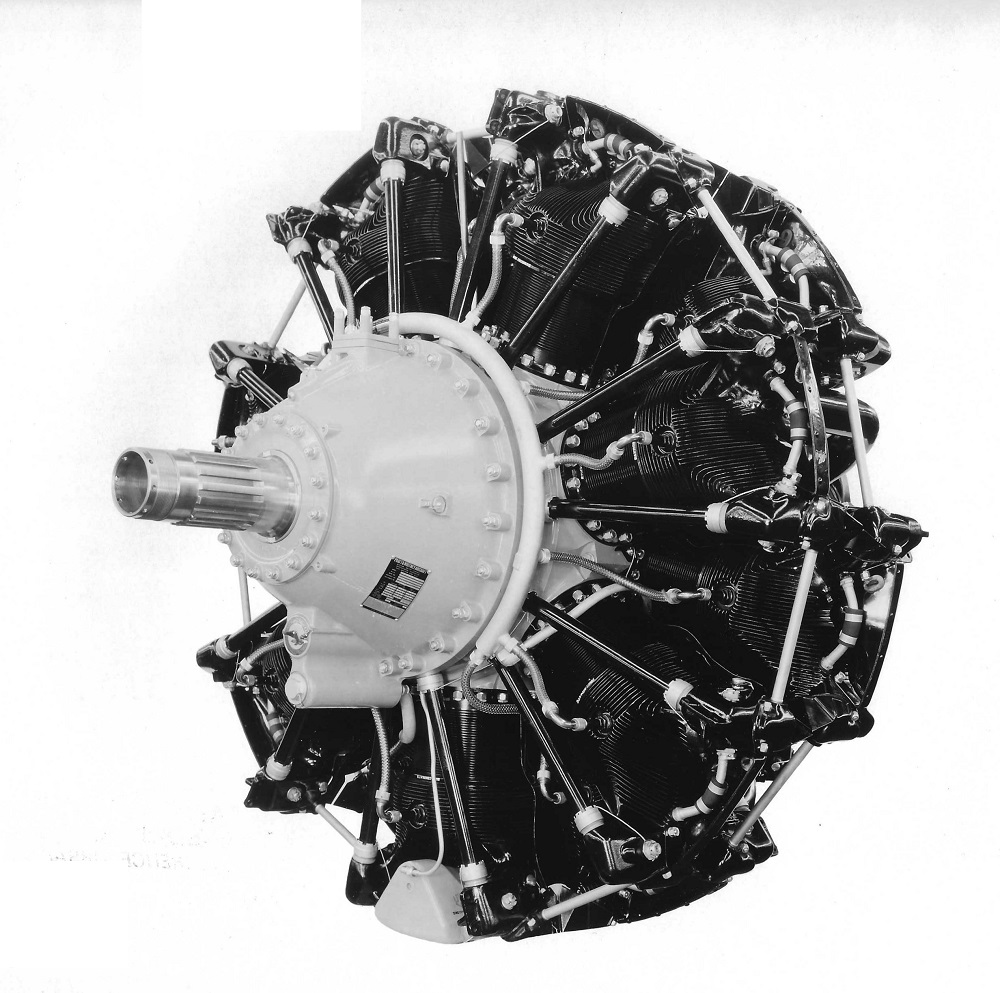
| Twin Wasp's displacement was 1,830 cubic inches. It produced 1,000 hp at 2,600 rpm for takeoff. | |||
|
Pratt & Whitney Aircraft, East Hartford, Conn., the engine manufacturing division of the United
Aircraft Corporation, produced and delivered approximately 1,300 engines during 1936. All
were in the higher horsepower classification, ranging from the 420 hp Wasp Junior to the 1,000
hp Twin Wasp. The total number of engines produced since the organization of the company in
1925 exceeded 11,000.
Basically, two types of Pratt & Whitney radial air-cooled engines were in current production, at the beginning of 1937--the nine cylinder single-row type and the 14 cylinder double-row type. Included in the first group are the Wasp Junior, the Wasp and the Hornet, and in the second, the Twin Wasp Junior and the Twin Wasp. Improvements in all those models made possible higher horsepower ratings both for take-off and for cruising. Considerable development in the double-row engine type was announced during the year at the time when the 1,000 hp Twin Wasp was offered for service. This development period extended back to 1929 when the company first began its double-row engine experimentation. Much interest for both commercial and military service has been shown in Pratt & Whitney's two double-row engines, and more than 1,000 of them have gone into service to date. The company stated that "advantages of the double-row power plant for aircraft are evident. Large displacement is possible with no increase, but actually a substantial decrease, in frontal area. This lends itself to plane design whether it be multi-engine or single-engine. The use of smaller cylinders permits greater crank speeds which in turn contribute to smooth operation and the smaller, more frequent power impulses further contribute to smoothness and long life." Distinctive and exclusive design features of current Pratt & Whitney engines included completely automatic valve gear lubrication, automatic mixture control, and improved cylinder head finning, which together with patented pressure baffles, provided maximum cooling and minimum fuel consumption. The policy of the company was based on the belief that future requirements for both military and commercial service will call for more horsepower than was available in 1936. Pratt & Whitney announced that the two-row type has the same possibilities for future development as the single row engine had a decade ago, and company engineers were working on the development and test of larger models of the two-row engine. Basically, Pratt & Whitney engines were divided into five distinct groups: The Wasp Junior, Wasp, Hornet, Twin Wasp and Twin Wasp Junior. In each engine group there were a number of different engines, each with a separate rating, but the general specifications of all engines in each group were identical. While Pratt & Whitney's available engine list contained a large number of units not referred to here, nevertheless, those which are discussed were the latest models appearing on their current production list at the beginning of 1937. The Wasp Junior had a displacement of 985 cubic inches, an overall diameter of 46-3/4 inches, and a bore and stroke of 5-3/16 inches. It could be had with either a geared or direct drive, the former weighing 800 pounds bare and the latter 596 pounds bare. The geared form, Model SC-G, the company reported, produced for take-off 600 hp at 2,850 rpm and delivered 525 hp at 2,700 rpm at 8,000 feet as a maximum power for continuous cruising. It had an overall length of 45-3/4 inches, a compression ratio of 6.7:1, and a blower ratio of 11:1, and 87-octane fuel is specified. Model SB was a direct drive Wasp Junior delivering 450 hp at 2,300 rpm for takeoff. Its maximum power for continuous operation was 400 hp at 2,200 rpm at 5,000 feet. Its overall length was 42-1/8 inches, compression ratio 6:1, blower ratio 10:1 and fuel specification 87-octane. Model TB was rated at 420 hp at 2,200 rpm at sea level and operated on 80-octane fuel, with a compression ratio of 6:1 and a blower ratio of 8:1. |
![]() | |
|---|---|
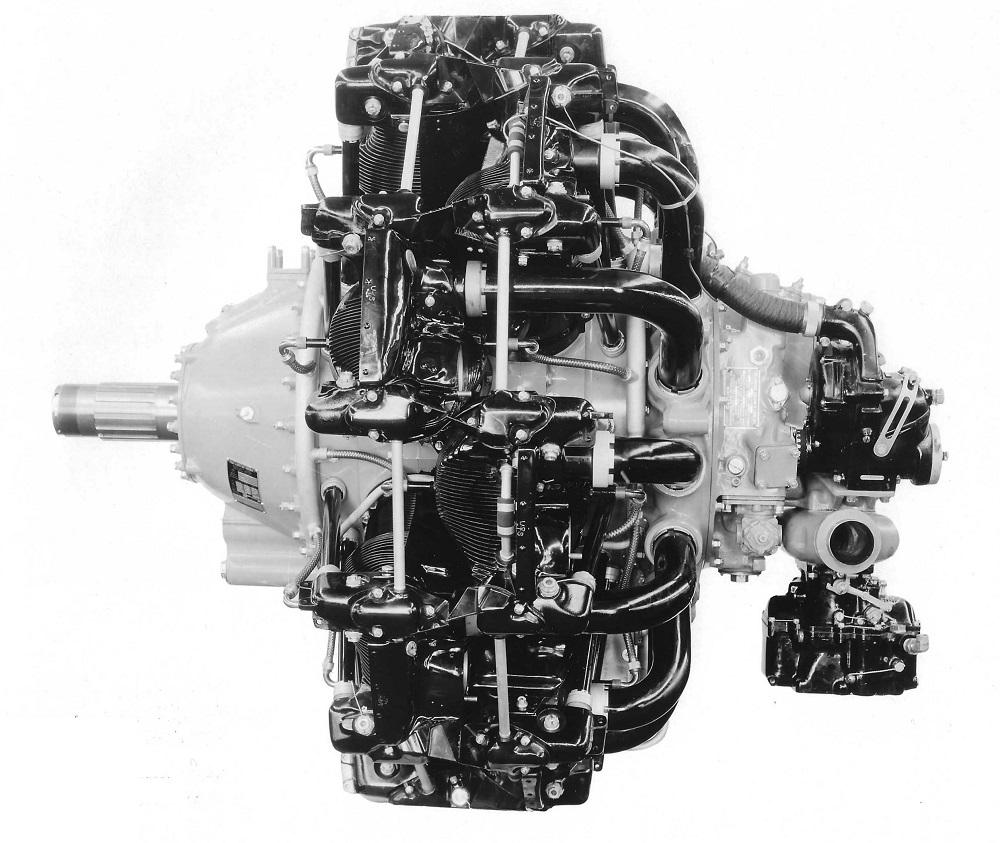
| The Wasp model SIHI-G provided 600 horsepower at 2,250 rpm with a displacement of 1,344 cubic inches. |
|
The Wasp group had a displacement of 1,344 cubic inches and an overall diameter of 51-7/16;
inches. Its bore and stroke were 5-3/4 inches and it also could be procured in either the direct
drive or geared form. The bare weight of the former was 798 pounds, and of the latter, 883
pounds. Model SIHI-G provided 600 horsepower at 2,250 rpm for take-off. Its compression
ratio was 6:1, blower gear ratio, 12:1 and 87-octane fuel was specified. Model S3HI, a
direct drive engine, was rated at 550 hp at 5,000 feet. It operated on 80-octane fuel, had a
compression ratio of 6:1 and a blower ratio of 10:1.
Three engines in the Hornet group in current production had a displacement of 1,690 cubic inches, a bore of 6-1/8 inches and stroke of 6-3/8 inches. The bare weight of the geared versions was 1,015 pounds and of the direct drive, 920 pounds. Overall diameter was 54-7/16 inches. Model SIE-G permitted 800 hp at 2,300 rpm for take-off, and its maximum power for continuous operation was 750 hp at 2,250 rpm at 7,000 feet. It had a compression ratio of 6.5:1, blower ratio of 12:1 and operated on 87-octane fuel. Model S2E-G had a similar take-off rating but its power for continuous operation was 750 hp at 2,250 rpm at 2,500 feet. It had a compression ratio of 6:1, a blower ratio of 10:1 and also operated on 87-octane fuel. Model S5E was a direct drive Hornet rated at 700 hp at 2,050 rpm at 6,000 feet. It had a compression ratio of 6.5:1, blower ratio of 13:1 and a fuel specification of 87-octane. The Wasp Junior, Wasp and the Hornet were nine-cylinder single-row radials, while the Twin Wasp Junior and the Twin Wasp were 14 cylinder radial air-cooled power-plants of two-row design. The cylinders of these latter engines were arranged in two banks of seven cylinders each and were staggered for the purpose of adequate cooling. The Twin Wasp Junior had a displacement of 1,535 cubic inches while the Twin Wasp's displacement was 1,830 cubic inches. Twin Wasp Junior Model S2A4-G was rated at 700 hp at 2,500 rpm at 8,500 feet. Its overall diameter was 44-1/8 inches and its overall length 53-1/4 inches. It was a geared engine weighing 1,070 pounds and operating on 87-octane fuel; compression ratio, 6.7:1, blower gear ratio, 10:1. Twin Wasp Model SB-G also was a geared engine with a bare weight of 1,265 pounds. It produced 1,000 hp at 2,600 rpm for take-off and 950 horsepower at 2,250 rpm at 5,000 feet as a maximum for continuous cruising. Its bore and stroke were 5-1/2 inches and its overall diameter was 48 inches. Its compression ratio was 6.7:1 and its blower ratio, 12:1 while its fuel specification was 87 octane. |