|
 |
||||||
|---|---|---|---|---|---|---|---|
| Forces Acting on an Airplane |
 |
 |
 |
 |
 |
||
 |
 |
 |
 |
 |
|||
 |
||
|
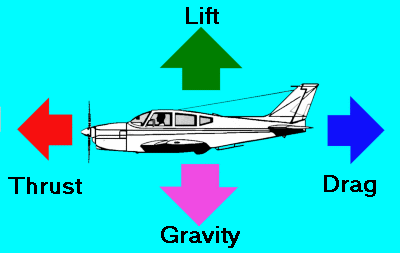
The airplane in straight-and-level unaccelerated flight is acted on by four
forces—lift, the upward acting force; weight, or gravity, the downward
acting force; thrust, the forward acting force; and drag, the backward
acting, or retarding force of wind resistance.
Thrust opposes drag. Drag and weight are forces inherent in anything lifted from the earth and moved through the air. Thrust and lift are artificially created forces used to overcome the forces of nature and enable an airplane to fly. The engine and propeller combination is designed to produce thrust to overcome drag. The wing is designed to produce lift to overcome the weight (or gravity). In straight-and-level, unaccelerated flight, (Straight-and-level flight is coordinated flight at a constant altitude and heading) lift equals weight and thrust equals drag, though lift and weight will not equal thrust and drag. Any inequality between lift and weight will result in the airplane entering a climb or descent. Any inequality between thrust and drag while maintaining straight-and-level flight will result in acceleration or deceleration until the two forces become balanced.
Drag = Constant x V 2 Lift and drag vary as the square of the velocity. The velocity of the relative wind passing over the wing is determined by the airspeed of the airplane. This means that as an airplane doubles its speed, lift and drag will quadruple as long as the angle of attack remains constant.1 |
|
1. AC-61-23A, Pilot's Handbook of Aeronautical Knowledge. (Washington, D.C.: Department of Transportation, Federal Aviation Administration, 1971). 7. |
Return to Aircraft Theory Index
© The Aviation History Online Museum. All rights reserved.
Created June 3, 2002. Updated June 8, 2015.