|
Chief company designer Kurt Tank's Wurger (Butcher Bird) was Germanys most
potent piston-powered World War II fighter When the Fw 190A entered combat
in the summer of 1941. It immediately outclassed the
Spitfire V,
which appeared sluggish and outdated by comparison.
From that time on, in spite of some severe problems with the
BMW 801 engine,
the 190 kept even or ahead of Allied fighters through successive versions.
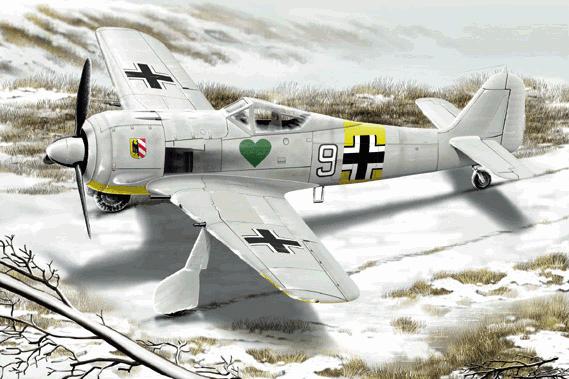
The Fw 190 was armed to the teeth. Four 20 mm cannon plus two machine guns.
Later versions could carry a 30 mm cannon firing through the propeller boss.
Early Fw 190s, powered by an air-cooled BMW radial, were Germany's first
radial-engined monoplane fighters. Shown above is the FW-190 of I./JG 54 Feldwebel Karl Schnorrer.
The BMW 801 engine tended to overheat, but this fault was
rectified by improvements to the cooling fan and, in general, the Fw 190A was highly praised by
the test pilots. They particularly favored the wide-track undercarriage which tremendously
improved ground stability as compared with the
Bf 109. One of the
unusual features of the fighter commented on by test pilots was the fact that, at high altitude and
high speed, the BMW 801 engine produced a pair of contrails which started immediately behind
the exhaust exits and completely hid the wings.
The Fw 190 prototype first flew on June 1, 1939 and production deliveries began in late 1940.
Within a year, Fw l90s were making low-level sweeps over southern England in daylight, against
which the
Spitfire Vs,
then in service, achieved little success. The situation did not improve until
the Royal Air Force received more powerful
Spitfire IXs,
in partnership with four-cannon Typhoons.
In the autumn of 1937, the Reichluftministerium (RLM) placed an order with the Focke-Wulf
Flugzeugbau for the design development of a new single-seat fighter to supplement the
Messerschmitt Bf 109.
A second "iron in the fire" as RLM officials referred to the order at the
time. The contract was placed with Focke-Wulf primarily because this company was not
extensively committed to the development of other combat aircraft and possessed a highly
qualified design team headed by Dipl.Ing.Kurt Tank. Tank's design team prepared two proposals;
one based upon the use of the
Daimler-Benz DB601 liquid-cooled engine and the other upon the
use of the BMW 801 air-cooled radial engine. At that time the radial engine was not favored as a fighter
power plant owing to its drag and the restrictions that its bulk placed upon forward view during
taking-off and landing and in consequence, General Ernst Udet's decision to proceed with the
development of the radial-engined fighter came as a profound surprise to Tank and his colleagues.
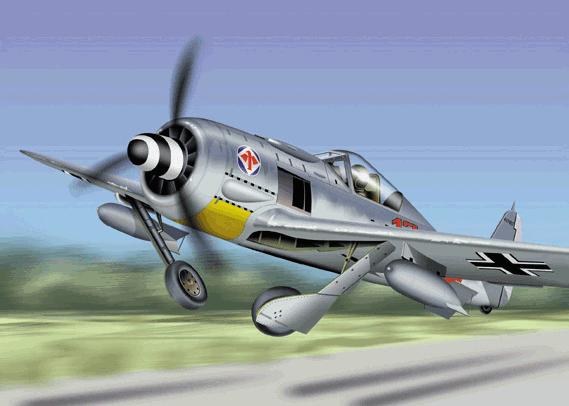
The FW-190 of II./JG 1 Maj. Heinz Bar.
The BMW 801 was a considerably heavier engine than its predecessor, although the overall dimensions differed little, and necessitated a stiffer engine mount and extensive structural strengthening. The re-design involved gave Blaser an opportunity to rectify one of the few faults
that had manifested themselves in the first prototype. Test pilots had objected to proximity of the engine to the cockpit which resulted in extremely high cabin temperatures, sometimes reaching 55 degrees C. (131 degrees F.) which as Sander said, felt as though he had his "feet in the fireplace." In
addition, exhaust gases found their way into the cockpit and necessitated the continuous use of an oxygen mask. Therefore in the next prototypes the cockpit was relocated further aft, a move also suggested by the c.g. problems presented by the heavier engine.
Most of the Fw 190A-0s were sent to Rechlin Roggenthin for pre-service tests. During intensive flight testing, it was discovered that the engine cowlings frequently flew off at high speeds and internally stressed cowlings with stronger locks were requested. Some re-stressing was also proved necessary and it was found that above 250 mph, the cockpit canopy could not be released in an emergency. The latter problem was solved by fitting two standard 20 mm cartridges which blew the rear end of the canopy backward far enough to let the slipstream get under it and pull it away. Pilots also complained that there was a serious risk of hitting the tail assembly when baling out and requested the fitting of some form of ejector seat which would throw them clear. However, in view of the serious weight penalty imposed by an ejector seat, the engineers refused to install this equipment, resulting in a serious disagreement between the test pilots and the manufacturers.
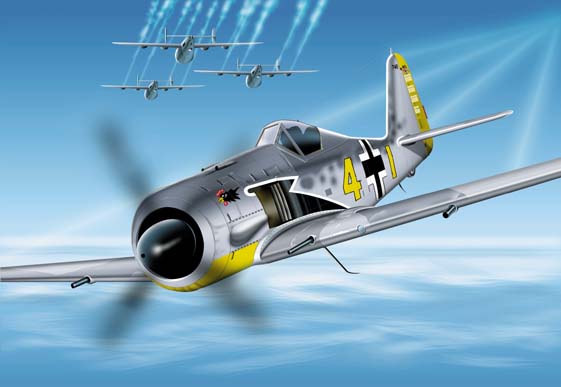
The FW-190 of 9./JG 2 Haupt. Siegfried Schnell, Vannes 1943.
The Focke-Wulf was not only faster but its superior handling and faster roll rate gave it an edge in the hands of even less experienced pilots. Such sparkling performance combined with the 190's superior armament presented Allied pilots with a real challenge until German pilot training began
to drop in quality. The standard Fw 190A was quickly modified to perform a number of roles, particularly that of fighter-bomber in the F and G versions. These deleted the outer 20 mm cannon in favor of various combinations of bomb racks or cannon pods for the MK 103 30 mm cannon. Later versions of the FW 190A featured up to six 20 mm cannon (FW 190A6R1); the A-6/R-6 had two 210 mm (8.27 in) unguided rockets with which to attack US heavy bombers. The wide
track landing gear assured ease of handling on takeoff and landing, unlike the twitchy
Messerschmitt 109. The 190 was also one of the first fighters to feature a clear rear canopy, allowing pilots to keep an excellent lookout for enemy fighters.
Meanwhile, the Fw 190 was also proving a good fighter-bomber carrying a reasonable bomb load or, in some cases, rocket projectiles. The new war started by Hitler on the Eastern Front resulted in most of the new production Fw 190s being thrown into the fighting against the Russians. Others were needed equally urgently by Rommel in North Africa to combat the Western Desert Air Force and Allied ground forces, who by the latter part of 1942, were pressing hard at Alamein.
As RAF and USAAF bombing raids got heavier and heavier in Europe, new tactics were employed by some German fighter units flying Fw 190s. Against US heavy bombers on daylight raids, several Fw 190s would form a queue and approach from the rear of the bomber formation. At very close range, the fighters would then 'open up,' so giving the rear gunners in the bombers very little chance of firing methodically at all the attackers.
During 1943, the Fw 190 was encountered frequently in Europe while performing night fighter missions. About the same time, the first Fw 190s came off the production line fitted with inline, rather than radial, engines. General appearance stayed the same, because of the use of an annular radiator at the nose.
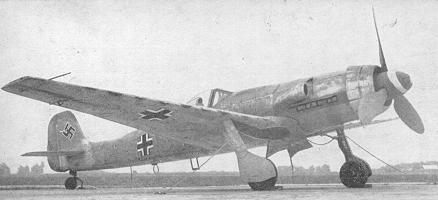
The long-nosed Fw 190D was also developed into the Ta 152 after its
designer, Kurt Tank-in which the installation of a 2,300 hp (with boost)
DB 603
engine pushed the speed up to 745km/h (463 mph). Had the Ta 152H been built
in enough numbers and been flown by expert pilots it could have taken its
place alongside the
Me 262
as a near unbeatable air superiority fighter and bomber killer.
The new Junkers Jumo 213 powerplant made the aircraft once again, the fastest Luftwaffe operational fighter and those pilots with the skill to use such advantages did very well. Unfortunately, excellent fighter designs could not compensate for poor production standards, lack of fuel, poor pilot training and overwhelming Allied numerical superiority.
In honor of designer Kurt Tank, the Fw 190's designation was changed to Tank or Ta 152. This beautiful inline-engined fighter was to be the ultimate version of the famous fighter but delays resulted in the stopgap Fw 190D, in itself an outstanding aircraft. In the chaotic final year of the Third Reich, the D ended up being the major inline engine version with only a few Ta 152Hs, and possibly a few Ta 152Cs, getting into combat.
The extended wing (14.5m), high altitude Ta 152H was indeed a sterling
performer with a top speed of 755 km/h (472 mph) and a service ceiling of 15,000 m (49,215 ft). It was armed with a 30 mm cannon in the nose and two 20 mm cannon in the wing roots. Had it been built in enough numbers and been
flown by expert pilots it could have taken its place alongside the Me 262 as a near unbeatable air superiority fighter and bomber killer. The lower altitude version, the Ta 152C, barely made it out of the test phase before the war ended. Between October 1944 and February 1945, when production ended, Focke-Wulf managed to roll 67 completed Ta 152 aircraft (H-0, H-1, and C-1 models) off the line. By the end of the war, more than 20,000 Fw 190s had been built; about one-third as fighter bombers.
|